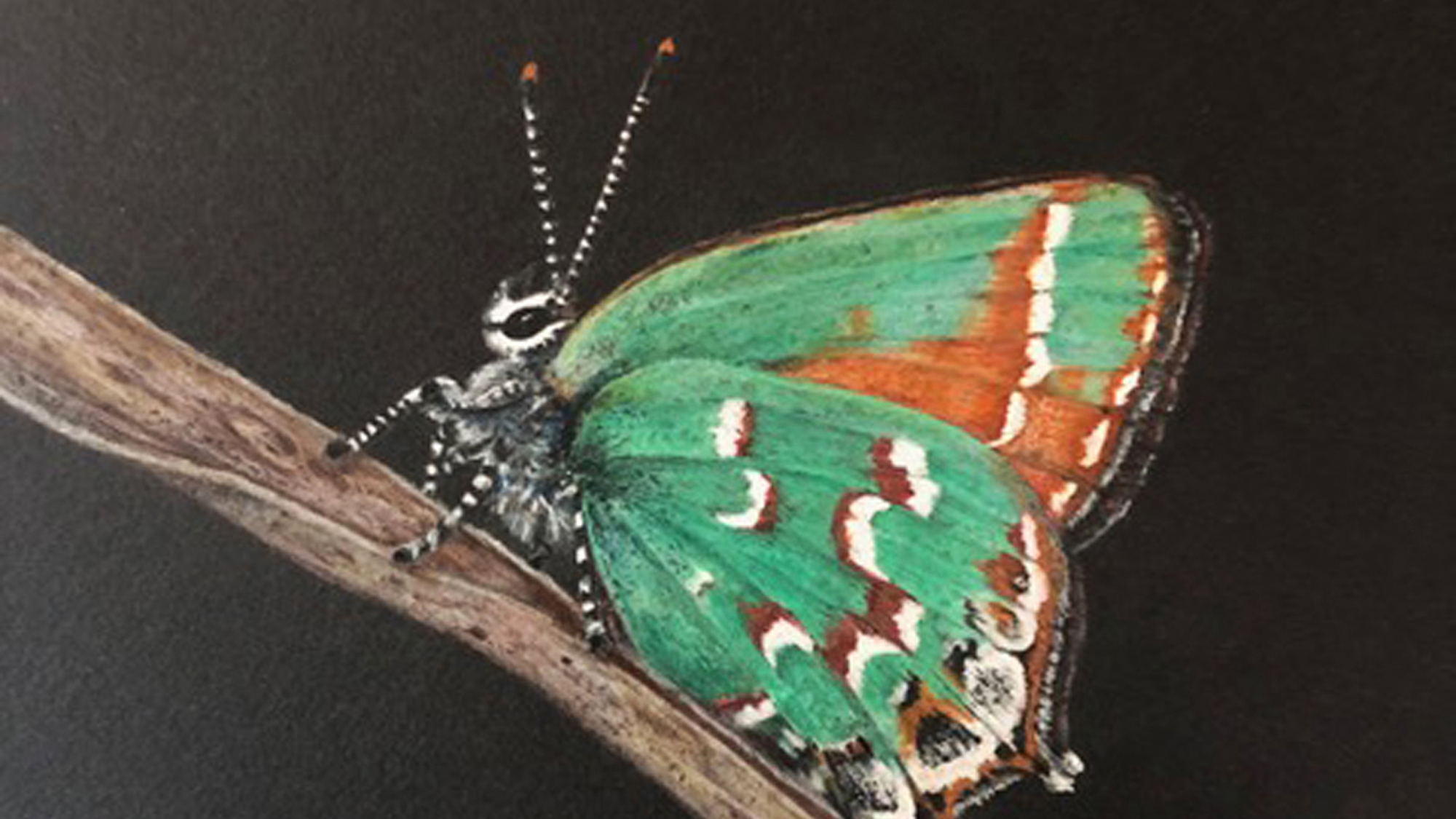
This class focuses on native invertebrates and their relationships with plants.
Adkins Arboretum • 12610 Eveland Road • Ridgely, MD 21660
Tuesday, March 9 & Wednesday, March 10, 2027 • 10 am–4 pm
Prerequisites: Botanical Drawing I and II, and some experience with colored pencil.
This class, instructed by Karen Coleman, CPSA, will focus on colored pencil working on drafting film and black paper. The focus will be on native insects, spiders, and other invertebrates and their relationships with plants. Including these under-appreciated creatures in botanical art helps show their unique and beautiful characteristics, their impact on plant life, and brings to attention their alarming decline worldwide.
Students are encouraged to pack a lunch. Questions about the class can be directed to instructor Karen Coleman.
Advance registration is required by Wednesday, March 3, 2027.
Materials List
- Invertebrate specimens
A few specimens and illustrated field guides will be available. Bring any specimens that you might have. Also, see the Maryland Biodiversity Project website for excellent photos. - Colored pencils
Bring a large artist-quality set of colored pencils that has a wide range of colors, such as Prismacolor Premier, Faber-Castell Polychromos, Caran d’Ache Luminance, or Derwent Coloursoft. Waxier pencils, such as Prismacolor, are the best option for working on drafting film. Be sure you have a white and a black pencil in your set. - Dura-Lar drafting film and black artist’s paper will be provided.
- Saral white transfer paper
This is needed to transfer your drawing to black paper. Small pieces will be provided for the practice exercise. You will only need to bring your own Saral if you opt to do your final drawing on black paper. - Drawing board
Any lightweight, smooth board, sized about 12” x 14”, or at least 1” larger than your drawing paper on all sides. Matboard works well for this. If your board is not smooth, tape a few sheets of newsprint or tracing paper to the surface. - Sketching supplies
Bring your usual sketching paper, graphite pencils (HB or your preference), erasers (kneaded, Tombow Mono Zero, soft white eraser), tracing paper, artist tape, draftsman’s brush or small, soft brush or air lens blower for removing pencil crumbs from work. - Pencil sharpener
Bring a battery-operated electric sharpener or a handheld with a container for shavings, whichever you prefer - Colorless Blender
A non-pigmented, wax blender pencil that can be sharpened (Prismacolor, Lyra, or Caran d’Ache) - Large sturdy coffee mug, glass jar, or something similar to serve as a container for the colored pencils you are using at any given time
- Magnifying glass
- Ballpoint pen
- Optional but not required: Prismacolor Verithins, eraser shield
Meet Your Instructor
Karen Coleman has been drawing and painting most of her life, often inspired by nature. Along the way, she fell in love with the world of plants and traditional botanical art. In 2010, Karen earned a Certificate of Botanical Art & Illustration from the Brookside Gardens School, Maryland. Her works include colored pencil, watercolor, graphite, and pen and ink. One of her favorites is colored pencil, which she finds allows a great deal of flexibility and depth of color while producing wonderful visual results. Her works have been shown in many local and international exhibitions, appear in a variety of books and publications, and are in the permanent collection of the Hunt Institute for Botanical Documentation.
Cancellation Policy